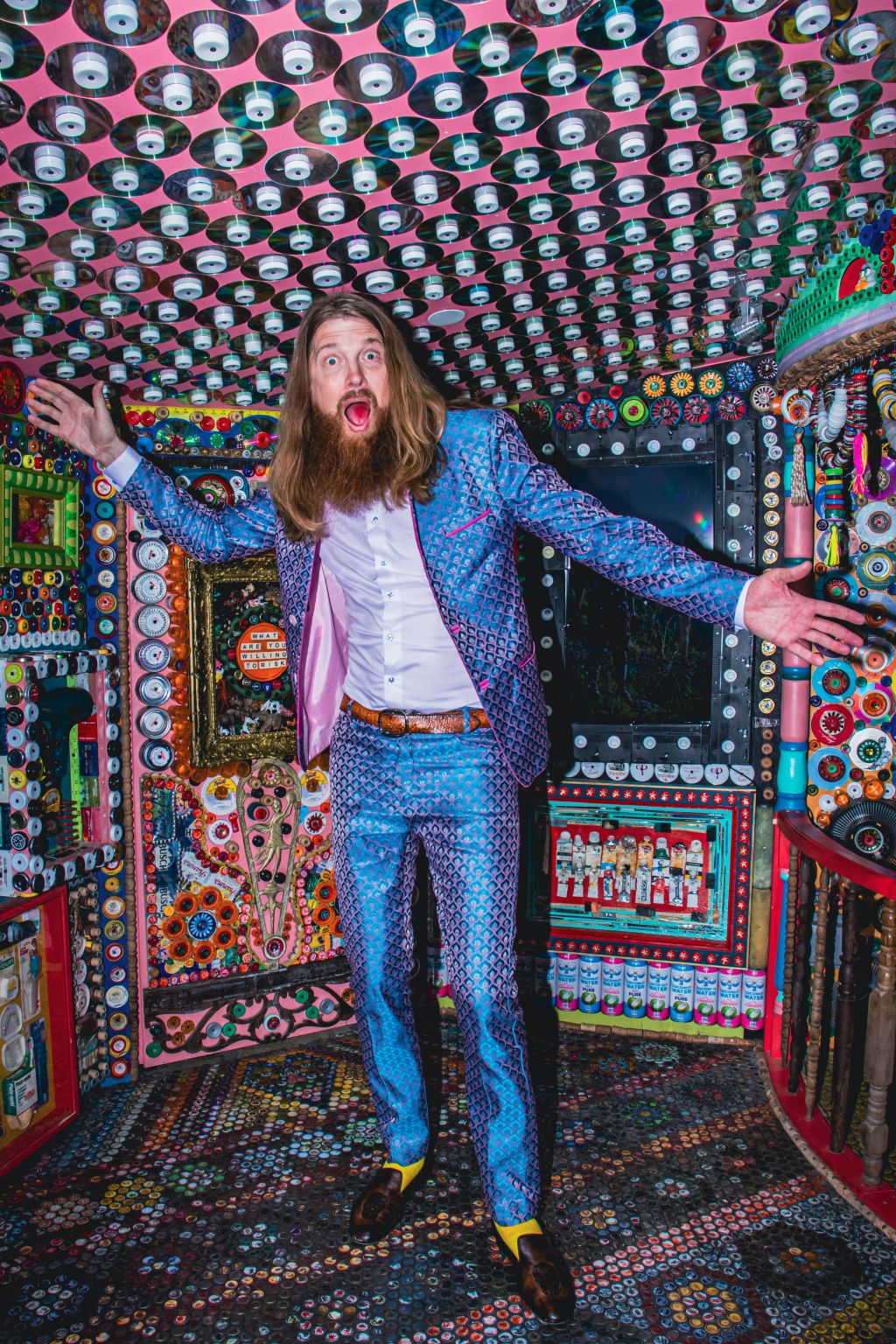
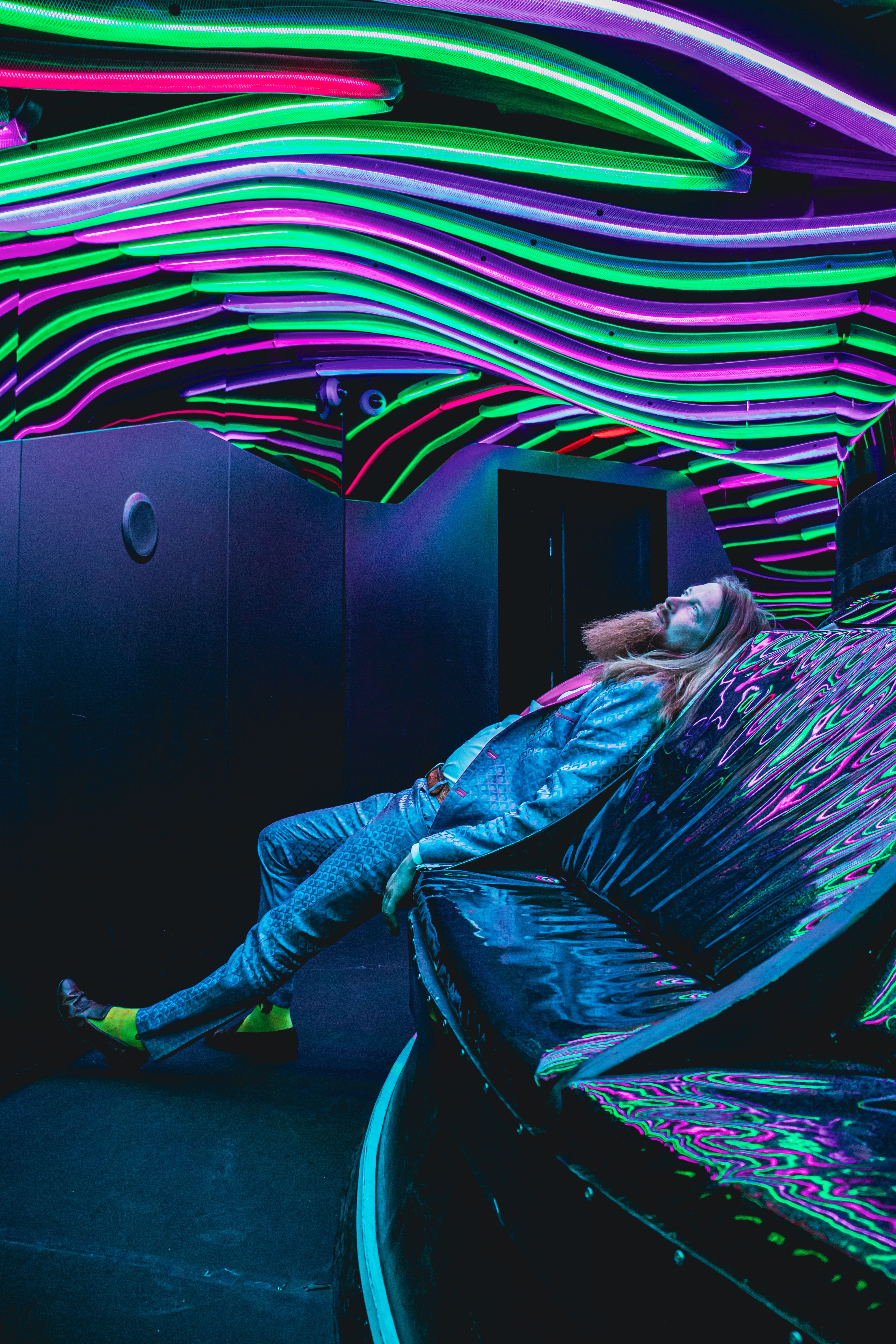
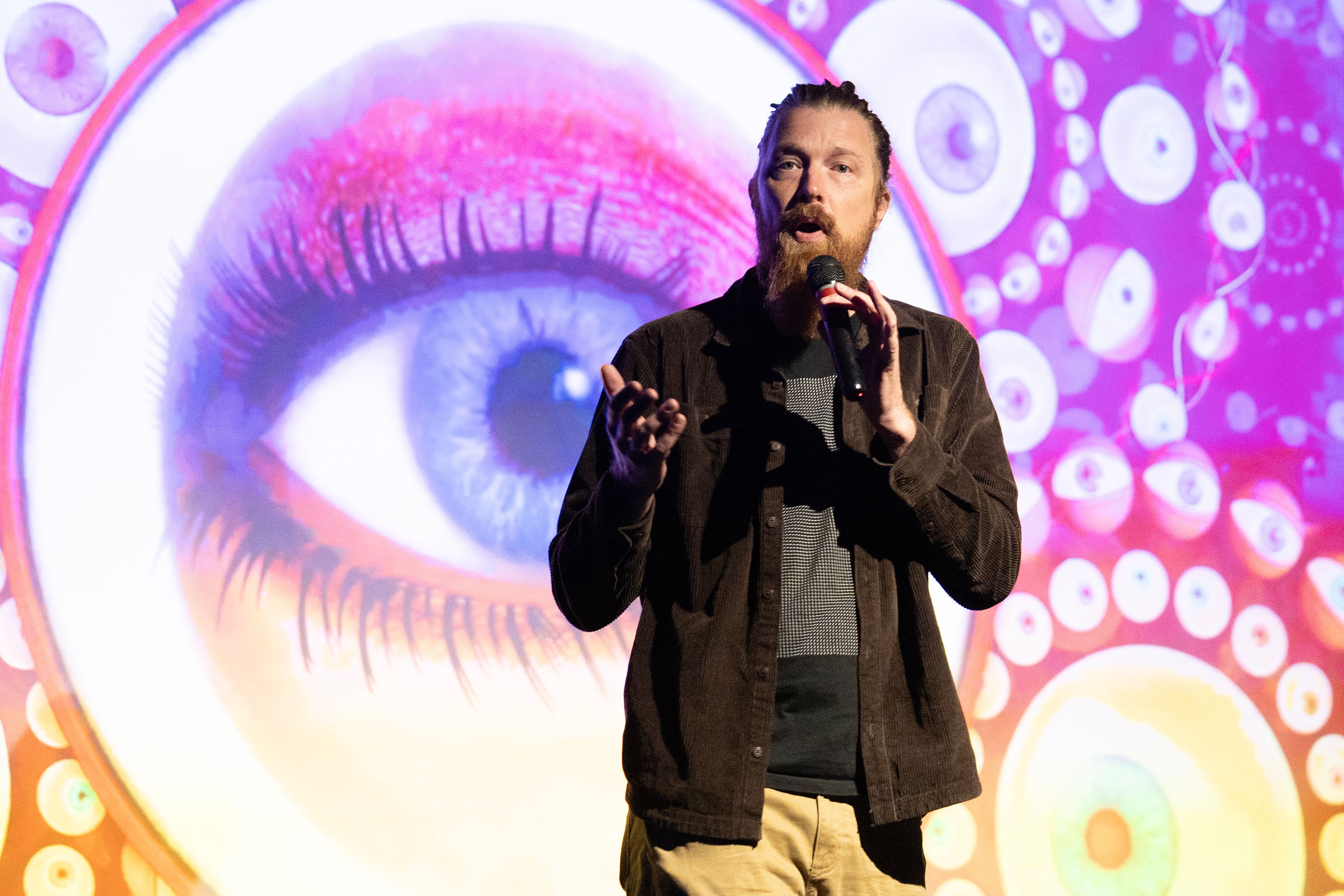
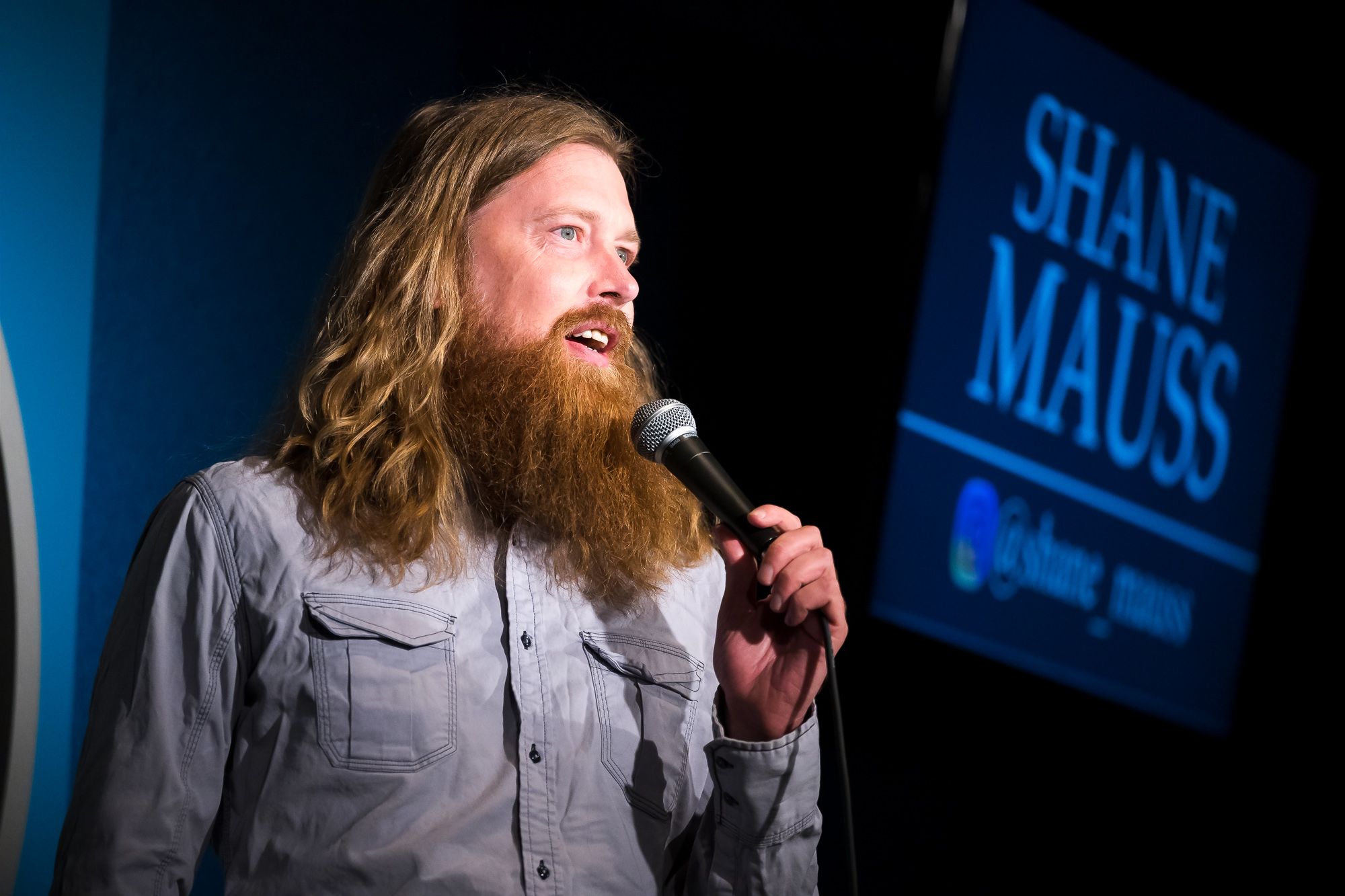
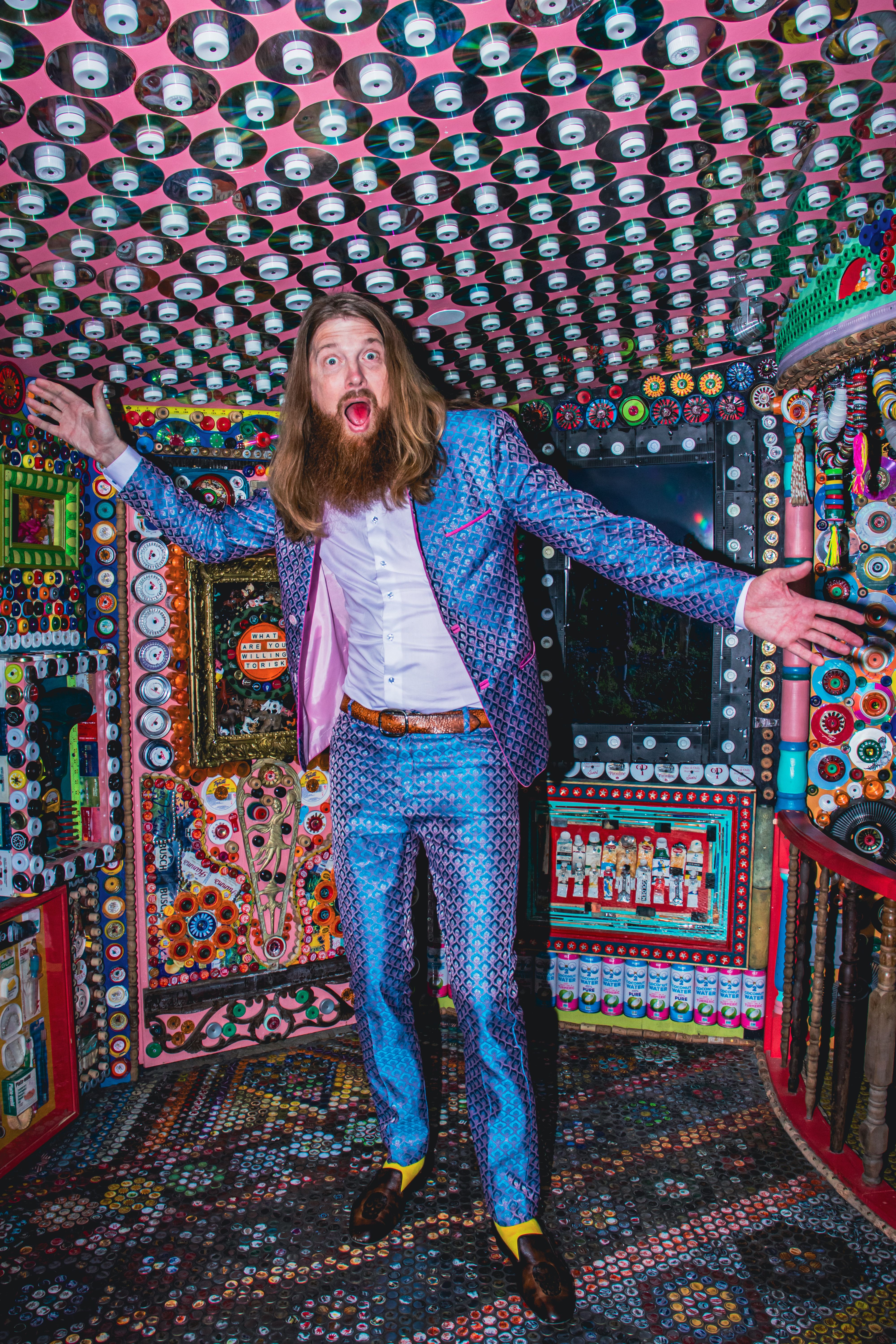
Shane Mauss is a talented stand-up comedian who has been perfecting his craft for over 20 years. With a deep interest in science, psychedelics, and consciousness, Mauss is at the cultural forefront of dissecting off-kilter topics. Over the last 3 months, Mauss has been hard at work putting out a brand-new trilogy of stand-up specials, all centered around the psychedelic theme. This time, incorporating an innovative set design, visual projections, and visionary artwork from around the world.
Hosted at Denver’s very own Meow Wolf Convergence Station, check out The Third Dose and the final iteration of this trilogy on June 4, 2026. Prior to the show, I spoke with Mauss over the phone to discuss the show’s origins and the current psychedelic landscape.
This interview has been edited for length and clarity.
IS: So, you’ve been a pioneer of the integration of psychedelics and comedy for many years. We actually spoke first over 10 years ago, when you were in the midst of a Good Trip Tour. How would you say your approach to infusing Psychedelic concepts into your comedy has changed over that time period?
SM: Well, the psychedelic space has changed so much in that time. I mean, back then, it was real scrappy and enthusiastic. It was very rebellious. There was a kind of energy where there were enough people excited about it to fill a room, but it was still very taboo.
People were wondering if there was an undercover cop in the room or if I was a cop. There was still a lot of fear and caution, and a sense of rebellion around it.
And now it’s gotten so normalized and so integrated with different groups. Especially since COVID, and with many of the decriminalization laws, it’s just changed so much.
And there’s no chill psychedelic people. Every little group within it is fighting for legitimacy or something and needs its perspective to be the correct one. Then the mystical side of things are just convinced that they’re tuned in to having special interactions with deities that are giving them privileged information, and everyone must believe they have to say. The wellness community thinks that this is part of becoming immortal or whatever. And you’re a fool if you aren’t doing this microdose regimen while clicking your heels together.
There’s the old hippie side of it, where it’s not cool anymore because everyone’s doing it. So they’re over it and looking for the next cool thing to care about.
Then there’s the psychedelic tourism, which was ratcheted up by novelty. So now ayahuasca is not as cool as it used to be, you need to do 5-MEO-DMT, because that’s the new one that everyone’s talking about.
It’s gone from making sure I’m providing some 101 and kind of basic information. Maybe make a reasonable case for policy change and point out the early corrupt history of some of the prohibitions on this stuff. Those were the kind of topics that were important and necessary 10 years ago. Now, it’s like…oh, everyone knows that. Now I’m trying to provide a sort of balanced perspective, where you’re giving a nod to and maybe a gentle rib poking to all of these different groups and facets within an ever-expanding community.
IS: Yeah, I definitely noticed some of that in the first 2 Trip specials. You kind of touch on the spiritual aspects, but then also discuss the science or wellness side. So, that’s really cool to hear.
SM: Yeah, I’m glad you got a chance to check them out.
IS: Since then, you’ve been touring and putting out content relentlessly. From the “Here We Are” podcast and “Tales from the Trip” to the “Psychonautics” documentary and the “Trip” specials. You really seem to keep pushing the boundaries with these types of shows and presenting the information in different ways. Do you think it’s important to present this type of information in new and exciting ways?
Courtesy Shane Mauss/Milkstream Media
SM: Yeah, with adding visuals and stuff, it’s always been about how I can figure out more ways to make this relatable and interesting to people.
I have a third dose show that I’m doing live, but I’m kind of working on a lot of shows. Most of my energy over the last year has been building shows with other topics unrelated to psychedelics.
So I have this show, Myth Understanding, that I just started experimenting with. We are starting “Here We Are” again and doing a lot more with science communication. Science-infused philosophical shows where it’s way different than traditional Stand-up. I’m trying to make sure that it’s not just a TED Talk, either. Trying to find that balance between something that’s beyond the traditional setup punch, that’s a lot of stand-up comedy, and can be a little shallow or low-hanging fruit.
Sometimes I’m on stage, and I’m like, oh, I’m just giving a science talk right now. I need to figure out ways to liven this up a little bit for the general public. Because I did put the word comedy in the description. So it’s always a balance.
When I put together sets, I always think of it as building a house. First, I’d think about the foundation. That would be the thesis statement, or what I’m trying to say, overall, with the show.
And then, figuring out the outline is like framing the house. Figuring out what I want to say is all of the necessary inner work, like the insulation, the pipes, and all of that.
Then the actual comedy part of it is the last thing I think about. I think about it as the detail work. It’s the molding, the paint, and everything aesthetic. It would look weird without the paint, but the paint’s not what’s holding the thing up.
Shane Mauss
So it’s just a different approach than 20-some years ago, when I started comedy. Back then, it was just that you had a funny thought or said something funny off the cuff and wrote it down so you could replicate it on stage. The whole point was just to get a laugh. Then you string together jokes that get laughs and don’t necessarily say anything. So yeah, it’s just been a different approach in that way.
Courtesy Shane Mauss/Milkstream Media
IS: Yeah, that’s a really cool analogy of how you kind of build out a show with these larger topics that are really complex. Do you think you’re gonna involve any of the visual projection stuff you did in these previous shows in these new shows that you’re working on?
SM: Yeah, we already are. We won’t have the LED screen behind it because that was a special thing we needed installed for the special. There will be some screens to the side of the stage, but every venue is a little different, too.
I was just in Crested Butte, Colorado, doing the Mountain Words Book Festival, and we did my Myth Understandings show there with a bunch of visuals and everything to go along with it.
So yeah, that’s the plan.
IS: So, speaking of the visual projection aspects of the Trip specials, you talked a little bit about where that idea came from, but can you just touch on that a little bit more? Was it a friend of yours who was a visual artist who was like, “Hey, you should combine this,” or did you have the idea yourself?
I’ve been wanting to do this since the Good Trip Tour that I talked to you about. The creator of “Tales From the Trip,” Grant Lindell, had seen that show, and it inspired “Tales From the Trip” on Comedy Central. So, I shot the pilot for that show.
At the same time, I would have art and different merch and stuff made with my friend Ramin Nazer, with whom we eventually did the show “Mind Under Matter.” We made a piece of art for each episode.
And then being at different festivals and meeting different psychedelic artists and everything. I had been slowly becoming interested in integrating more artwork into my show, but I just didn’t really know how to do it without it feeling like a PowerPoint presentation.
Then I met Michael Strauss, the VJ who blends all the art together and creates the dynamic visuals. We met at a conference where I saw him providing the visuals for various talks and things. I realized that was how I was going to pull off adding the visuals and everything.
So yeah, it all just came together over the years.
I pitched it to this place, Area 15 in Vegas, and so we did a little residency there back in 2023. Then we figured out how we could take it on the road. We weren’t sure we could pull it off across a bunch of different venues with different screen sizes and stuff, but we figured it out. So that’s how it all came together.
IS: So, for this third one, is it gonna be a brand new batch of different visionary artists and stuff?
There’s going to be some of the same artists, and then some of the VJ packs and stuff like that. I kind of leave it up to Michael to assemble the early pieces of work.
I don’t fully know what the show will be. I know that I have hours of material that we can use. And then I kind of have an idea of what the show’s structure will be. This one is a little more about some of the crazy things that happened along the way.
I kind of leave it up to him, in the beginning, until we actually start going, okay, this is going to be a tour. Then we go through the visuals and get a lot more specific. But, yeah, some of the same artists will be involved; it’s just mostly Michael arranging that right now.
IS: Following a 2026 executive order, the FDA is expediting the research and clinical trials into ibogaine for PTSD and severe mental illness. Do you think this means we are getting closer to psychedelic decriminalization and acceptance, or do you feel like this was just a minor political ploy, and doesn’t really help us in that advancement?
Well, I think it was a political ploy…. and it probably will help open up a few other things. It’s kind of hard to speed up the advancement of the most dangerous psychedelic that there is, without maybe opening up a little bit of flexibility for studying things that are less problematic.
Mushrooms and LSD just have this historical baggage with them. You know, with ibogaine, you can have some politician or Donald Trump, who doesn’t even know how to pronounce the thing. And so it doesn’t have a lot of the same baggage and associations. It’s associated with opioid addiction. So it’s kind of associated with cleaning up the streets.
Courtesy Shane Mauss/Milkstream Media
Mushrooms and LSD are more associated with being a lazy, far-out hippie who doesn’t know anything. They respect mushrooms to the extent that you can microdose them and be better at the gym or work in Silicon Valley. It’s public perception-driven. So, I think that there’s still a long way to go in steering public perception.
I’m not necessarily going to be the one to do it, because I’m a long-haired, bearded hippie-looking guy. And actually don’t really care much about psychedelics these days, compared to my many other interests.
Right now, there’s just been a push to see how we can get conservatives to do psychedelics. And there’s going to be an eventual, careful what you wish for sort of situation that will probably come along when you realize that psychedelics just amplify everyone’s personalities.
I think that there’s a lot of potential. I think it’s probably a good thing that ibogaine is being studied more and that psychedelics are being thought to be studied more.
And probably a bad thing, if the way the world works is that we are dependent on hoping the right podcaster sends the right text , and that’s how laws and happen.
I don’t look forward to living in a world where that’s how things are determined to be legal.
IS: Yeah, we’re definitely getting closer to idiocracy with that.
Yeah, I’d like to, I’d like to see a more science-driven world. Not a cherry-picked and pseudoscience-driven world that’s more about pandering to populism than public health organizing societies. So that’s my convoluted take on it.
IS: No, those are some great points on public perception and how public perception kind of reflects a lot of these things. So you’ve spoken about pseudo spirituality and like that narcissistic spiritual aspect of psychedelics…
SM: Well, I’m not saying that the spirituality and mystic side of things is inherently wrong; I’m saying that there are ways in which it certainly gets extreme and emboldens the ego a little bit. I think a big part is just not saying you for sure have the answers. You can be interested in the mystic side of it, but don’t discount the science aspect, or that there are other aspects that may be able to be used by psychedelics.
Every group within the psychedelic community should be able to accept that they might be wrong. And people will say, “what about science, shouldn’t they accept that they could be wrong?”
Yeah, that’s actually their whole thing haha….
They’re pursuing what they are wrong about from the onset. The whole thing is you test and see f you can try to disprove your own ideas and then have peers and people with expertise and blind spots outside of yours see if they can disprove the ideas as well.
Courtesy Shane Mauss/Milkstream Media
But once again, it’s Joe Rogan’s world right now? And we’re all just dying in it. Whatever he has said has become some sacred truth. There are these fun ideas, like the Stoned Ape Theory, that are so much fun to tell people and to imagine. And also, they are probably not even close to true.
It’s probably more the case that psychedelics were pretty specific to the Americas. At least more than their perpetuation as this old, ancient, sacred thing. Ayahuasca is probably only about 300 years old.
That’s the problem: a lot of the psychedelic culture doesn’t scale. If you go to some festival or something, and someone has a booth where they can blow some magic tobacco up your nose….I have hape on me right now and I will probably do it today. So, when I say these things, don’t get me wrong.
It’s a silly fucking thing to do, and at the same time, it’s part of the reason why I enjoy doing it.
But anyway, you go to a festival, and they have all sorts of potions or whatever there. And that’s great to be at a festival and hear some spiel about this and that. Or a plant that’s gonna help your urine be healthier or whatever the pitch is. That’s terrific. You’re gonna spend a little too much money on it, and then it’s gonna get left on your shelf. And you’re not really gonna use it that much.
That’s adorable. Life’s about finding the placebo that works for you. Once you take those things and start scaling them up. And now they’re in Whole Foods and everywhere else. Well, now we’re just selling placebos to the masses.
Placebos have become so profitable that there’s a lot of motivated reasoning to peddle conspiracies about science and medicine. It starts getting really dubious and starts becoming everything that the psychedelic community was supposedly fighting against. Becoming worse than Big Pharma to a certain extent.
IS: That’s a great point. That’s actually pretty interesting, because I kind of always had this narrative that psychedelic use is this ancient concept, and then the idea that it potentially isn’t is just cool to think about. I should probably do more research on that topic.
SM: There’s a really fantastic book I highly recommend by Manvir Singh, who is an anthropologist and evolutionary biologist at UC Davis. He put out a book, I think last year, “Shamanism: a timeless religion.” And he’s gone in and done a lot of field work and has a really wonderful, balanced perspective. He doesn’t dismiss a lot of these practices, but he doesn’t romanticize them much either.
There’s not really, like, hunter-gatherers in the same sense anymore, but there are still people trying their darndest to, you know, live in a traditional way and preserve historical rituals. So he’s done a lot of studying on that.
He has a whole chapter dedicated to psychedelics in it, and it’s definitely a different perspective. And I think he’s gotten a lot of attention from the psychedelic community for it, but he’s a lot more skeptical of a lot of the claims than what a lot of people are saying.
But again, we’ve just gotten through a decade of thinking Graham Hancock is a legitimate scientist because he’s finding some underground water world. What’s the fucking thing called?
IS: The lost city of Atlantis?
SM: Oh yeah, like the lost city of Atlantis. You know, 20 years ago, when I got into science, shows like Bigfoot and Ancient Aliens were this hilarious thing people would watch for a laugh.
And now that’s just like what people think Science is 20 years later. So maybe that’s what it took to get people interested in even thinking about science in a more scientific way. Maybe we’ll all be growing up a little bit over the next 10 years. Who knows, I’d say that’s optimistic. AI is going to determine a lot of whether we’re heading into an idiocracy or not.
IS: So, a concept that comes up in some psychedelic literature is the cosmic giggle. Do you find a link between psychedelics and humor?
SM: Absolutely, I mean, a lot of what psychedelics are is unknown situations. Sometimes these states can feel dubious or not go the way that you had hoped or intended. And there can be paranoia and depersonalization and all sorts of existential crises and really scary things that can come along with the psychedelic experience.
Humor is kind of the mix in between. I was just recently hanging out with my buddy, Peter McGraw, who wrote this book called “The Humor Code.” A UC Boulder Professor. He has a benign violation theory, which was the standard and is now being expanded on. And the idea is that things can be either too much of a violation to be funny or too boring and benign to be funny. And that sweet spot in between is where the humor is.
I think a lot of that in the psychedelic space is when you have these like really disorienting ideas or hallucinations, but also a recognition that these are just passing moments. And this is just the peculiarities of the weird ways in which perception can be altered. Psychedelics are always on that fine line. I mean, of course, they can be just the most magical, lovely experiences as well, and then you’re just laughing about how incredible life is.
Laughter’s a good barometer for knowing if you’re in the perfect Goldilocks zone during a psychedelic state, and in life, in general.
And you see this seriousness of some of the holistic or wellness people within the space. And it’s because they’re just playing it a little too safe. That’s why they aren’t laughing. And then if you’re taking too much of a chance, now, you’ve put yourself in a lot of danger, and that’s not funny either. That’s the downside of some of the recreational side of things. So, I think when you’re balanced, you’re laughing.
Courtesy Shane Mauss/Milkstream Media
IS: Yeah, no, that’s a fascinating perspective. Some of my favorite times on psychedelics are when I had a really scary thought or a moment. And then I’m laughing at how silly I was for being so scared.
SM: Hell, yeah, man, I love that. Yeah, I mean that’s a huge part of it.
IS: You’ve talked a little bit about your craziest and scariest trips on some of those other podcasts that we mentioned. Can you talk a little bit about the most beautiful or revelatory trip that you’ve had?
SM: I hate to even say this, because I don’t think 5-MEO-DMT is something that people should be taking lightly. I’m like, oh boy, I’d be really worried about doing a thing where you can completely black out and lose control of your body. And also, you might just have a completely fucking horrifying experience. Which I have had. I have done it four times. Two times were among the worst experiences of my life, and two were among the very best.
So, it’s a real mixed bag for me. The first time I did it, it was amazing. Like a 10-minute trip, absolutely beautiful, and everything else. The trip, the visuals, and all of that were one thing, and I enjoyed it.
But the main thing was, I just felt every mental barrier in my life just vanish. And for like a month after that, I had no mental resistance whatsoever. An email that I’d normally put off, or like a bill that I wouldn’t pay, or some ambitious project that I was worried about starting.
I wasn’t manic. I was just in a perfect flow state. Just the best version of myself for like a month after, it was insane.
IS: That’s pretty cool that the glow could last for that long.
SM: It was incredible. And then I had a couple of beers one day, not thinking anything of it. And it turned off.
IS: Oh, no. It got dimmed away hahaha.
SM: I didn’t expect it to turn off the experience, just having a few beers, but it did, haha.


 Introspection Section
Leave a comment