

I remember the year 2011 vividly. I was a junior in high school and transitioning through every form of human evolution. My body was changing, my mind was maturing and I was seeking purpose. So, when I heard those ominous first keys of “In My Dreams,” I had no idea what I was in store for. Accompanied by my very first ingestion of psilocybin mushrooms, Kid Cudi meticulously guided my brain to a completely new realm of thinking. As “Sky Might Fall” blared through my headphones, golden rays of sunlight warmed my body and my soul. I felt as Cudi was communicating the exact mind state that I was experiencing and began finding a flood of relatable feelings. It was a powerful album listen that can never truly be encapsulated by words. That moment was a shaping experience for the rest of my life and my Cudi fandom has remained with me sense.
Man On the Moon: The End of Days was unlike anything I had ever experienced. I had never connected with an artist on such a visceral level. I was stunned and amazed at how much I related to the content of the music. Two older brothers, one hood one good/ An independent older sister kept me fly when she could/ But they all didn’t see/ The little bit of sadness in me, Cudi raps on “Soundtrack 2 my Life.” I have the same family make-up and the relatability to this line was inimitable.
A week or so later I went to Independent Records and purchased my first physical CD ever. It was Man on the Moon II: The Legend of Mr. Rager. I was captivated with the artwork and album aesthetic. At a time when album booklets were still a thing, I remember flipping through the book with fascination at the character that Cudi had created. The booklet features a unique scene of topless models, bloody soaked T-shirts and a visual representation of mental health. It was a work of art in itself.
The music on the second installment of the trilogy was just as vibrantly potent as the first. “Marijuana” and “Mojo So Dope” were already in constant rotation with YouTube, but the real treat of this album was a full playthrough. Something that is often overlooked by many of today’s young artist is album cohesion. A theme, an aesthetic, beautiful transitions and unique storytelling all come together to create a single body of work.

My growing interest in altered states of consciousness seemed to align with much of Cudi’s vision. I found relatability in the blunt nonchalance of “Wild’n Cuz I’m Young” and solace in the introspective outpouring on “All Along.” As many have stated over the years, Cudi was an outlet for the outsider. And that was something I needed. I needed to know that other men, or boys at the time, struggled with anxiety, depression. I needed to know it was ok to not be the ultimate cool guy all the time. It’s important for a young man to feel comfortable in the inevitable vulnerability that every human inherently carries.
MOTM2 was dark and brooding. It was a critical self-analysis of a man struggling with life and coping through substance. The teenager in me reveled in the chaos and fell deeper into fandom. The first two albums in the Man on the Moon trilogy are responsible for shaping the rest of my life. I had never felt such a vivid connection to the music an artist creates.
As for Cudi, his art also suffered. He followed up MOTM2 with two solid albums in Indicud and Satellite Flight: The Journey to Mother Moon. I personally wouldn’t mind Satellite Flight being placed in the MOTM Trilogy because of the quality of songs and subject matter explored. “Internal Bleeding” from that album is one of my favorite Cudi songs to date. In 2015, he released Speeding Bullet to Heaven and the feedback was less than positive. While he did market the album as alternative rock, many of the fans that fell in love with the first MOTM albums felt SBTH was a waste of a listen. And the people who listen to alternative rock felt the album was a poor attempt at channeling the genre. Anthony Fantano of The Needle Drop gave the album a 0 out of ten.
In 2016, Cudi returned with new music. He released Passion, Pain and Demon Slayin to a solid critic reception. Many fans felt PPDS was Cudi finally returning to the coveted MOTM style and form. “Frequency,” “Surfin” and “Baptized in Fire” all managed to reach the top 25 on the Billboard Hot 100 in 2016. This would be Cudi’s final solo release until the final chapter of MOTM. In 2018, he linked with Kanye West once again for another chart-topping album in Kids See Ghost.
This brings us to December, 11 2020. The release date for Cudi’s long awaited Man on the Moon 3: The Chosen. Released just shy of my daughter turning six-months-old and one of the most momentous time periods of my entire life. I was battling a severe case of depression and lack of self-worth. Now that I was a dad, I felt I wasn’t good enough. Something that I had never felt in the 24 years prior.
Thoughts raced back and forth through my mind. “You wasted your time with a journalism degree, you should have learned a trade.” “A father should know how to repair everything in the house and on the car.” I have since made some great strides in self-love and acceptance, but nothings ever perfect.
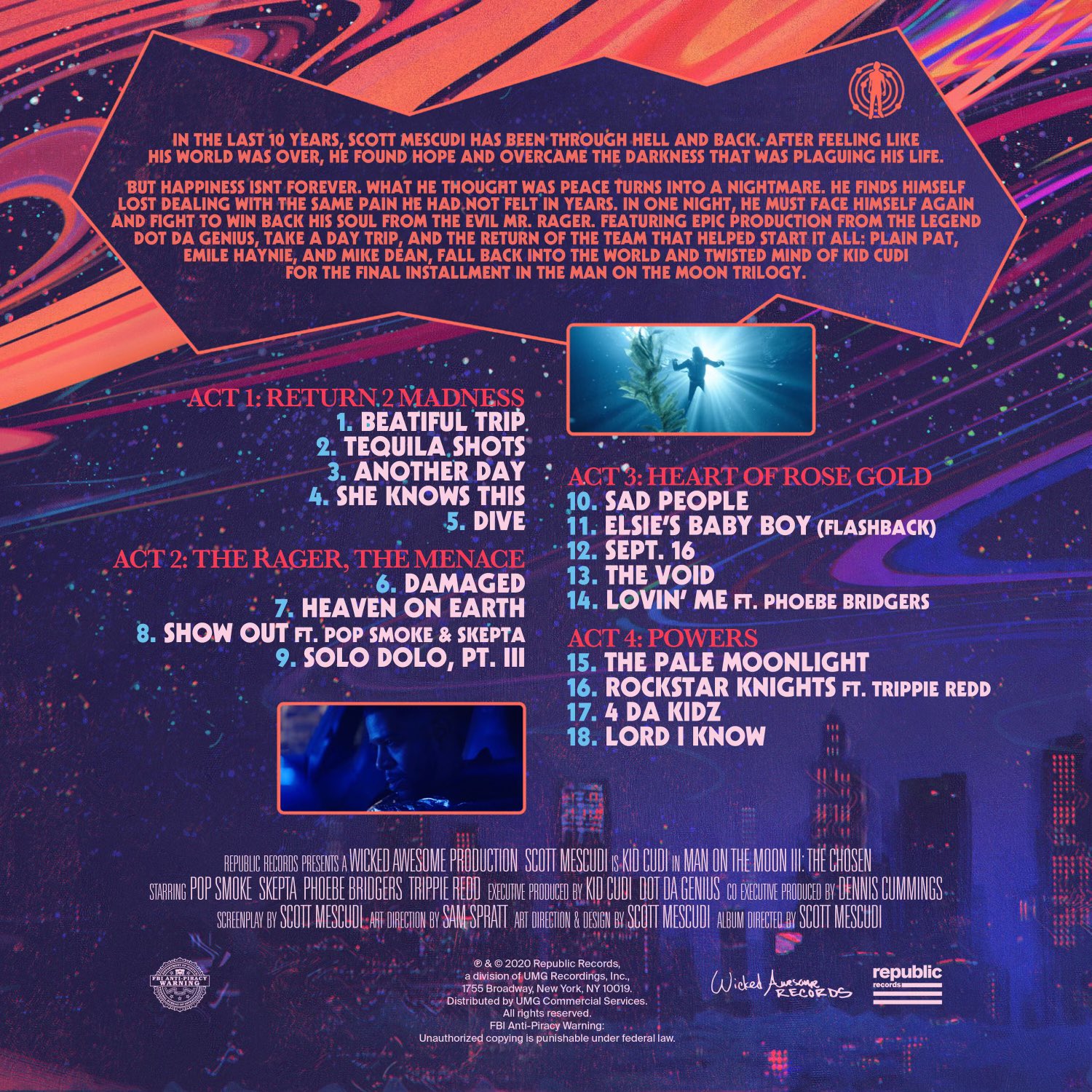
In the ten years between MOTM2 and MOTM3, I did a lot of growing up. As did Cudi. The back cover of the album has the following statement at the top: “In the last 10 years, Scott Mescudi has been through hell and back. After feeling like his world was over, he found hope and overcame the darkness that was plaguing his life.” For many lost souls around the world, Cudi is the beacon of hope that guides us out of our own darkness. I graduated High School, fell in love, lost loved ones, went to College, joined the Army and a slew of other experiences that go a long with adulthood. As the age of 25 swiftly approached, the weight of life was pushing down full force on my shoulders.
The first listen of MOTM3 was an hour-long therapy session. Act 1 immediately dives into the rager persona Cudi has cultivated. Aptly titled The return to madness, the first five songs of the album are a barrage of classic Cudi sounds. “Tequila shots” has the trademark humming and melodic singing that has brought many ears comfort in the last decade. The introspective chorus bellows out Can’t stop this war in me/ can’t stop this war in me. The rest of the first act is filled with perfectly crafted auto-tune melodies and aggressive lyrical outbursts. You can hear a lot of Travis Scott influence in the first half of MOTM3. This influence and sound continue into the second act of the album as well.
This confident auto-tune empowered Cudi continues through the Act 2 as well. “Show Out” is an impressive lyrical assault of confidence with features from Pop Smoke and popular grime artist Skepta. One thing that Cudi does an effective job of doing is connecting with human emotion. An important aspect of the human experience is being confident and comfortable in your own shoes. This confidence and self-love are a theme throughout the entirety of MOTM3. Regardless of some of the sadder topics touched on through the album, the ability to overcome life’s bullshit and find the fun in life is a constant theme for Cudi. So, no matter what hidden haymaker life threatens to swing at me, give me a few puffs from a blunt and a good beer and I will find the joy in any situation. The reliance on a substance for this revelation is a struggle that Cudi, myself and millions of people all over the world continue to fight. Cudi sums this up best on “Wild’n Cuz Im Young” when he raps, I guess the fact my father smoked And drank /made it a young nigga destiny to do the exact same.
The second half of MOTM3 picks up in an introspective space for Cudi. “Sad People” is an anthem for the “sad people who keep the blunt burning.” Elisa’s baby boy is a unique guitar sample that that finds Cudi singing auto-tune free about his family dynamics. The themes of isolation and sadness permeate through the record. “I was so bored in the winter/ just a little sad boy/ just a little sad boy,” Cudi wails over the guitar riff. Cudi continues a tour of human emotion through the second half of the album and plants the seeds of self-acceptance and love. Towards the end of the “The Void,” Cudi delivers a intimate call to action for the listener. “It will be ok, trust me…It will be ok, I promise.” I would be lying If I said I was not in tears by this point in the album. Cudi finishes the album with a positive direction on Act 4. It seems the moon man has finally conquered his demons and is ready to progress forward.
As my first listen ended, I wiped my tears and felt an immense amount of joy. I was worried I wouldn’t like the long-awaited follow-up. It was almost too good to be true. But in true visionary fashion, Cudi delivers again with another masterpiece. Arguably the best album in the trilogy, MOTM3 certifies Cudi as the goat of “Your music saved my life.” This idea can be argued for days; however, the fact is clear cut. Kid Cudi has had an immense impact on the lives of millions of people all over the world. The level of impact varies between person, but from my own experience, I would be a drastically different human being without the beautiful art created by Scott Mescudi.
 Introspection Section
Leave a comment